
Chapter 2 - Representing and Manipulating Information
0 写在前面
应该是要开始第一个lab了
2026/08/21 终于看完了第一遍
2026/08/22 开始做Data Lab!
2026/08/25 做完Data Lab了,技巧要求确实比较高,不过总算是做完了,之后写一篇总结(希望别鸽
现代计算机存储并处理信息,这些信息以二值信号表示。这些二进制数字,或者bits(位),形成了数字革命的基础。
人类有十个手指头,用十进制是很自然的(原来还有这层解释),但是在构建能存储并处理信息的机器上,二进制值做得更好。二值信号能够很容易地被表示、存储和传输,比如,可以表示为穿孔卡片上有没有洞、导线上是高电压还是低电压、磁场是顺时针还是逆时针。
对二值信号进行存储和执行运算的电子电路很简单且可靠,使得制造厂可以集成百万甚至数十亿这样的电路到一个单独的硅片上。
单个的bit并不是很有用,当我们把bit组合到一起并应用一些interpretation(解释),即赋予不同的可能的bit的组合以含义,我们就能表示任意一个有限集里的元素(怎么感觉是离散数学的结论)。比如,用一个二进制数系统,我们可以用几组bit来编码非负数,使用标准的字符码,我们可以能对文档中的字母和符号纪念性编码,我们后面会讨论。
我们考虑三种重要的数字的表示方法,unsigned(无符号) 编码基于传统的二进制表示法,表示大于等于0的数字;two’s-complement(补码) 编码是表示 signed(有符号) 整数的普遍方式。floating-point(浮点数) 编码是表示实数的科学计数法的以2为基数的版本。计算机用这些不同的表示方法实现算术运算。
计算机的表示方法使用有限数量的bit去编码一个数字,因此导致了当结果太大而不能被表示时,一些操作可能会overflow(溢出),例如,使用4个byte表示int类型的计算机,如果计算
200 * 300 * 400 * 500
就会得到-884901888
不过,整数的计算机运算满足许多整数运算的性质,比如乘法的结合律和交换律
1 | int main() |
虽然结果是错的,但都是-884901888
浮点运算有完全不同的数学性质,虽然溢出会产生特殊的值(正无穷),但一组正数的乘积总是正的
1 | // 以下代码来自ai |
浮点数的表示的精度是有限的,所以浮点运算不可结合
1 | int main() |
整数运算和浮点数运算有不同数学性质是因为它们处理数字表示有限性的方式不同,整数的表示虽然只能编码一个相对较小的数值范围但表示是精确的,浮点数的表示只是近似的
1 Information Storage
Rather than accessing individual bits in memory, most computers use blocks of 8 bits, or bytes, as the smallest addressable unit of memory.
A machine-level program views memory as a very large array of bytes, referred to as virtual memory. Every byte of memory is identified by a unique number, known as its address, and the set of all possible addresses is known as the virtual address space. This virtual address space is just a conceptual image presented to the machine-level program.
In subsequent chapters, we will cover how the compiler and run-time system partitions this memory space into more manageable units to store the different program objects, that is, program data, instructions, and control information. Various mechanisms are used to allocate and manage the storage for different parts of the program This management is all performed within the virtual address space.
1.1 Hexadecimal Notation
1个字节由8个bit组成,二进制中,它的范围是00000000到11111111,十进制中是0到255
用十六进制表示比较方便,即00到FF
在C语言中,以0x或0X开头的数字常量被认为是十六进制的值,比如0xFA1D37B
二进制转十六进制,整数部分从右往左四个一组,不够可以补0,然后对应到十六进制,小数部分从左往右四个一组,不够可以补0,然后对应到十六进制
1.2 Data Sizes
Every computer has a word size(字长), indicating the nominal(标称) size of pointer data. Since a virtual address is encoded by such a word, the most important system parameter determined by the word size is the maximum size of the virtual address space.
对于一个字长为位的机器,虚拟地址的范围就是0到,程序最多能访问个字节。我们平常说的64位机器,就是指64位字长机器。
大多数64位机器也可以运行为32位机器编译的程序,这是一种向后兼容。
计算机和编译器支持使用不同方式编码(或者不同长度编码)数据的多种数据形式,比如整数和浮点数。
例如,许多机器有能处理单个字节(比如C语言的char)的指令,也有能处理用2个、4个或8个byte表示的整数的指令,也有处理用4个、8个byte表示的浮点数的指令。
在C语言中,整数可以是signed,也可以是unsigned,前者可以表示正数、0、负数,后者只能表示非负数。数据类型char表示一个单独的字节,虽然char这个名字源于它用来存储一个字符,但它也可以存整数。
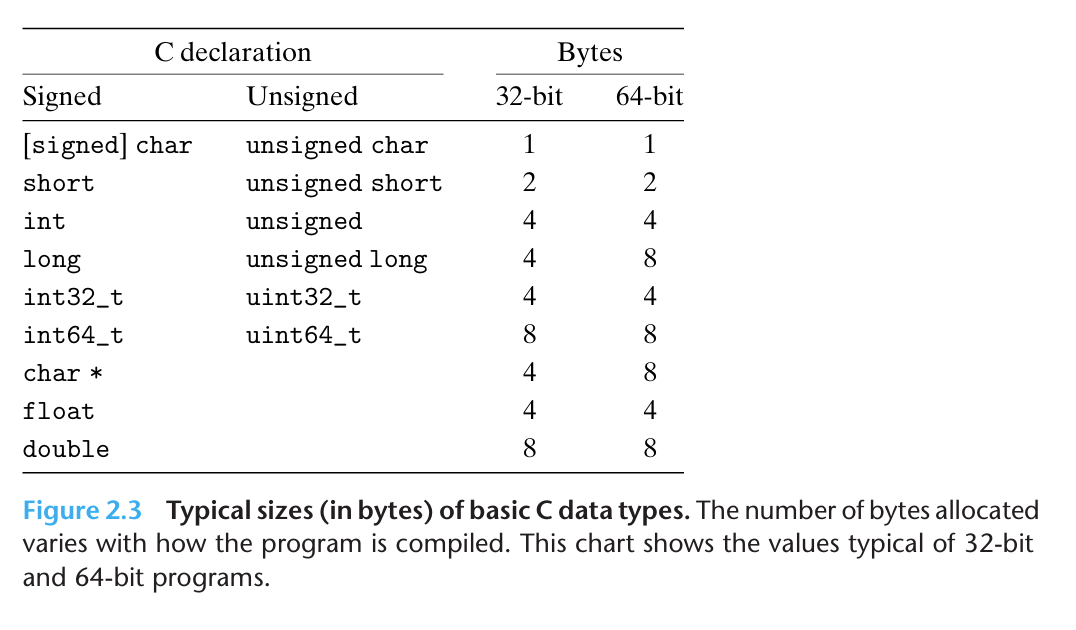
int, short, long提供各种数据的不同大小,即使是为64位系统编译,int类型通常只有4个字节,long一般在32位程序中为4字节,在64位程序中为8字节。
To avoid the vagaries(奇怪行为) of relying on “typical” sizes and different compiler settings, ISO C99 introduced a class of data types where the data sizes are fixed regardless of compiler and machine settings.
Among these are data types int32_t and int64_t, having exactly 4 and 8 bytes, respectively. Using fixed-size integer types is the best way for programmers to have close control over data representations.
大部分数据类型都编码为有符号数值,除非前面有关键字unsigned,例外是char,尽管大多数编译器和机器将大部分数据类型视为有符号数,不过对于char,这点并不保证,即默认下有可能是无符号也可能是有符号的,可以用signed char或unsigned char明确指出,不过一般char有无符号没什么关系。
程序员应力图使他们的程序在不同的机器和编译器上可移植(portable),可移植性的一个特点就是程序对不同数据类型的确切大小不敏感。
比如,之前32位机器广泛使用,许多程序员以为一个int类型的对象可以存储指针,这在64位的机器上会导致问题。
1.3 Addressing and Byte Ordering
For program objects that span multiple bytes, we must establish two conventions: what the address of the object will be, and how wewill order the bytes in memory. In virtually all machines, a multi-byte object is stored as a contiguous sequence of bytes, with the address of the object given by the smallest address of the bytes
used.
For example, suppose a variable x of type int has address 0x100; that is, the value of the address expression &x is 0x100. Then (assuming data type int has a 32-bit representation) the 4 bytes of x would be stored in memory locations 0x100, 0x101, 0x102, and 0x103.
排列用于表示对象的字节,有两种方式。
考虑一个位的整数,用bit表示,即[]
是最高位,是最低位,假设是8的倍数,那么最高字节包含位[]
一些机器选择在内存中按照从最低字节到最高字节的顺序存储对象,另一些机器按照从最高字节到最低字节的顺序存储,前者称为little endian(小端法),后者称为big endian(大端法)
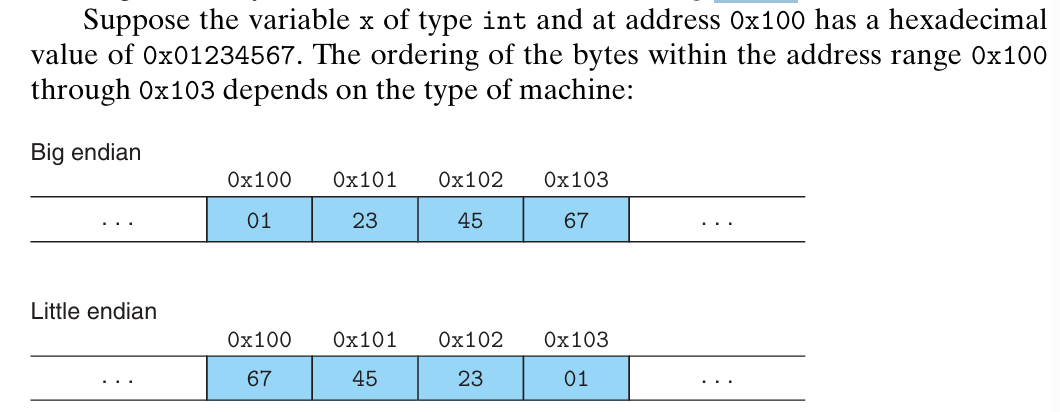
对大多数程序员来说,机器所使用的字节顺序是不可见的,无论为哪种类型的机器所编译的程序都会得到同样的结果,不过有时候字节顺序会成为问题
- 不同类型的机器间通过网络传送二进制数据式,小端法机器产生的数据被发送到大端法机器或者反过来时,接收程序会发现字里的字节是反序的
- 阅读表示整数数据的字节序列时,字节顺序也很重要,先省略,如果后面没讲再写
- 当编写规避正常的类型系统的程序时,比如C语言中强制类型转换等,这种编码技巧及其不推荐,但它们对系统级编程是非常有用的
1 |
|
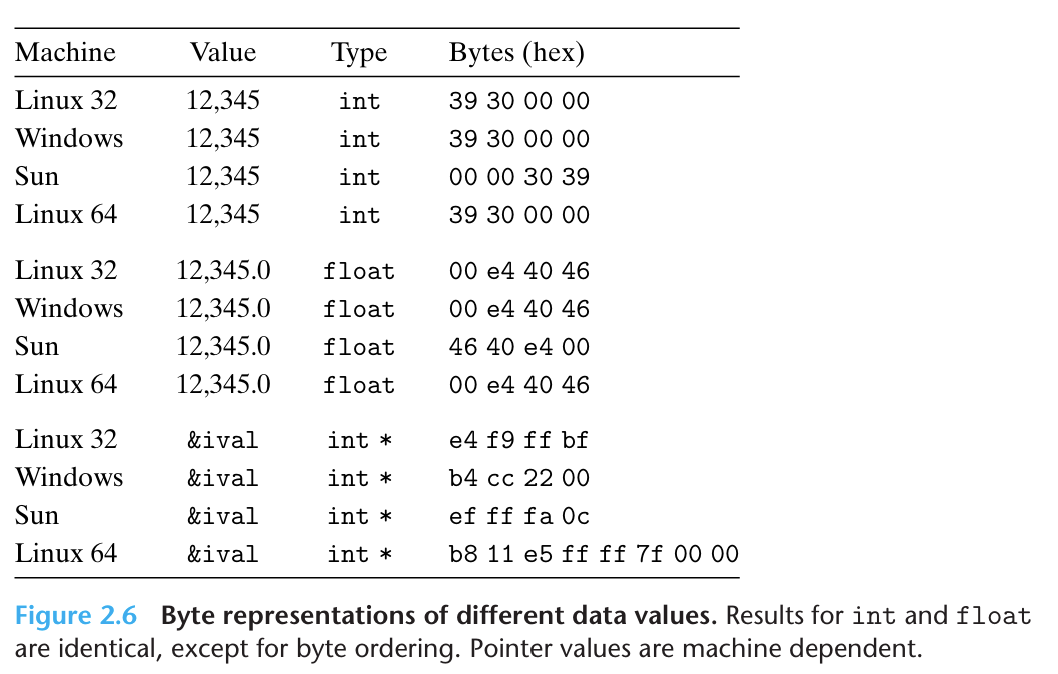
12345的十六进制表示是0x00003039
可以看到Sun是一个采用大端法的机器,其余都是使用小端法,先存储最低字节
1.4 Representing Strings
A string in C is encoded by an array of characters terminated by the null(having value 0) character.Each character is represented by some standard encoding, with the most common being the ASCII character code.
注意字符串的存储没有最高字节最低字节之分,字节顺序是固定的,例如,在使用ASCII码作为字符码的任何系统上,show_bytes("12345", 6);得到的结果都是31 32 33 34 35 00
1.5 Representing Code
1 | int sum(int x, int y) |
When compiled on different machines, the generated machine codes are different.
Different machine types use different and incompatible(不兼容的) instructions and encodings. Even identical processors running different operating systems have differences in their coding conventions and hence are not binary compatible.
Binary code is seldom portable across different combinations of machine and operating system. A fundamental concept of computer systems is that a program, from the perspective of the machine, is simply a sequence of bytes. The machine has no information about the original source program, except perhaps some auxiliary(辅助的) tables maintained to aid in debugging.
1.6 Introduction to Boolean Algebra
Since binary values are at the core of how computers encode, store, and manipu
late information, a rich body of mathematical knowledge has evolved around the study of the values 0 and 1.
The simplest Boolean algebra is defined over the two-element set {0, 1}.
与、或、非、异或
We can extend the four Boolean operations to also operate on bit vectors, strings of zeros and ones of some fixed length .
1.7 Bit-Level Operations in C
One useful feature of C is that it supports bitwise(按位的) Boolean operations.
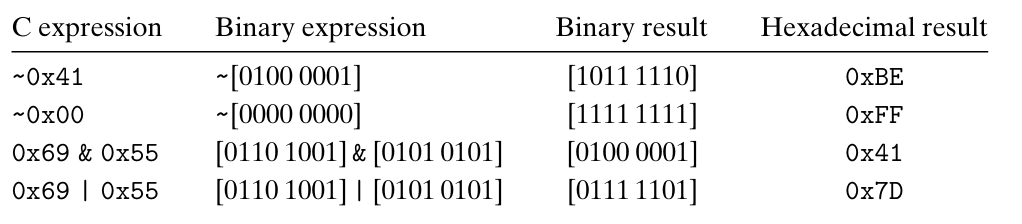
One common use of bit-level operations is to implement masking(掩码) operations, where a mask is a bit pattern that indicates a selected set of bits within a word. As an example,the mask 0xFF (having ones for the least significant 8 bits) indicates the low-order byte of a word. The bit-level operation x & 0xFF yields a value consisting of the least significant byte of x, but with all other bytes set to 0. For example, with x = 0x89ABCDEF, the expression would yield 0x000000EF.
The expression ~0 will yield a mask of all ones, regardless of the size of the data representation(即不管字的大小是多少). The same mask can be written 0xFFFFFFFF when data type int is 32 bits, but it would not be as portable.
1.8 Logical Operations in C
C also provides a set of logical operators ||, &&, and !. These can easily be confused with the bit-level operations, but their behavior is quite different. The logical operations treat
any nonzero argument as representing TRUE and argument 0 as representing FALSE. They return either 1 or 0, indicating a result of either TRUE or FALSE, respectively.
The logical operators do not
evaluate their second argument if the result of the expression can be determined
by evaluating the first argument. Thus, for example, the expression a && 5/a will never cause a division by zero, and the expression p && *p++ will never cause the dereferencing(解引用) of a null pointer.
1.9 Shift Operations in C
C also provides a set of shift(移位) operations for shifting bit patterns to the left and to the right.
For an operand x having bit representation [], the C expression x << k yields a value with bit representation []. That is, x is shifted k bits to the left, dropping off the k most significant bits and filling the right end with k zeros. The shift amount should be a value between 0 and . Shift operations associate from left to right, so x << j << k is equivalent to (x << j) << k.
Generally, machines support two forms of right shift.
- Logical. A logical right shift fills the left end with zeros.
- Arithmetic. An arithmetic right shift fills the left end with repetitions of the most significant bit.
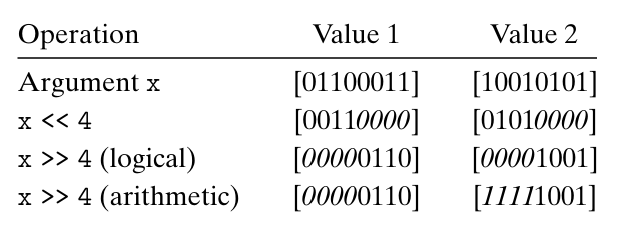
C语言标准没有明确定义对于有符号数应该使用哪种类型的右移,所以如果假设一种或者另一种右移形式的代码可能会遇到可移植性问题。实际上,几乎所有的编译器/机器组合都对有符号数使用算术右移。对无符号数,一定是逻辑右移。
2 Integer Representations
In this section, we describe two different ways bits can be used to encode integers — one that can only represent nonnegative numbers, and one that can represent negative, zero, and positive numbers.
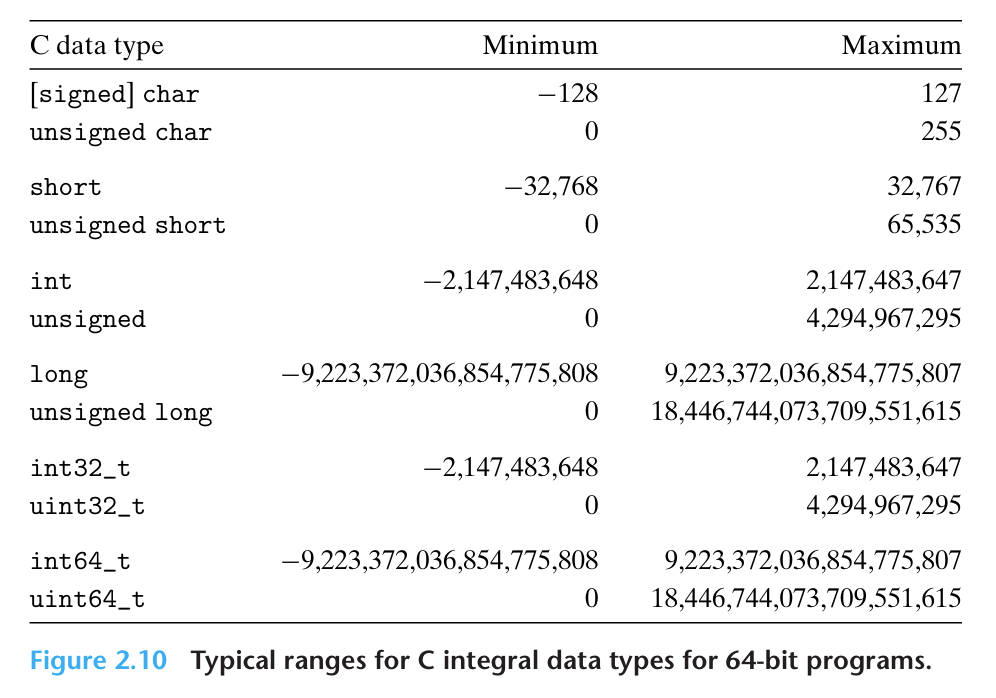
2.1 Integral Data Types
C supports a variety of integral data types — ones that represent finite ranges of integers.
Each type can specify a size with keyword char, short, long, as well as an indication of whether the represented numbers are all nonnegative (declared as unsigned), or possibly negative (the default.)
2.2 Unsigned Encodings
Let us consider an integer data type of bits. We write a bit vector as either to denote the entire vector, or as [] to denote the individual bits within the vector. Treating as a number written in binary notation, we obtain the unsigned interpretation of .
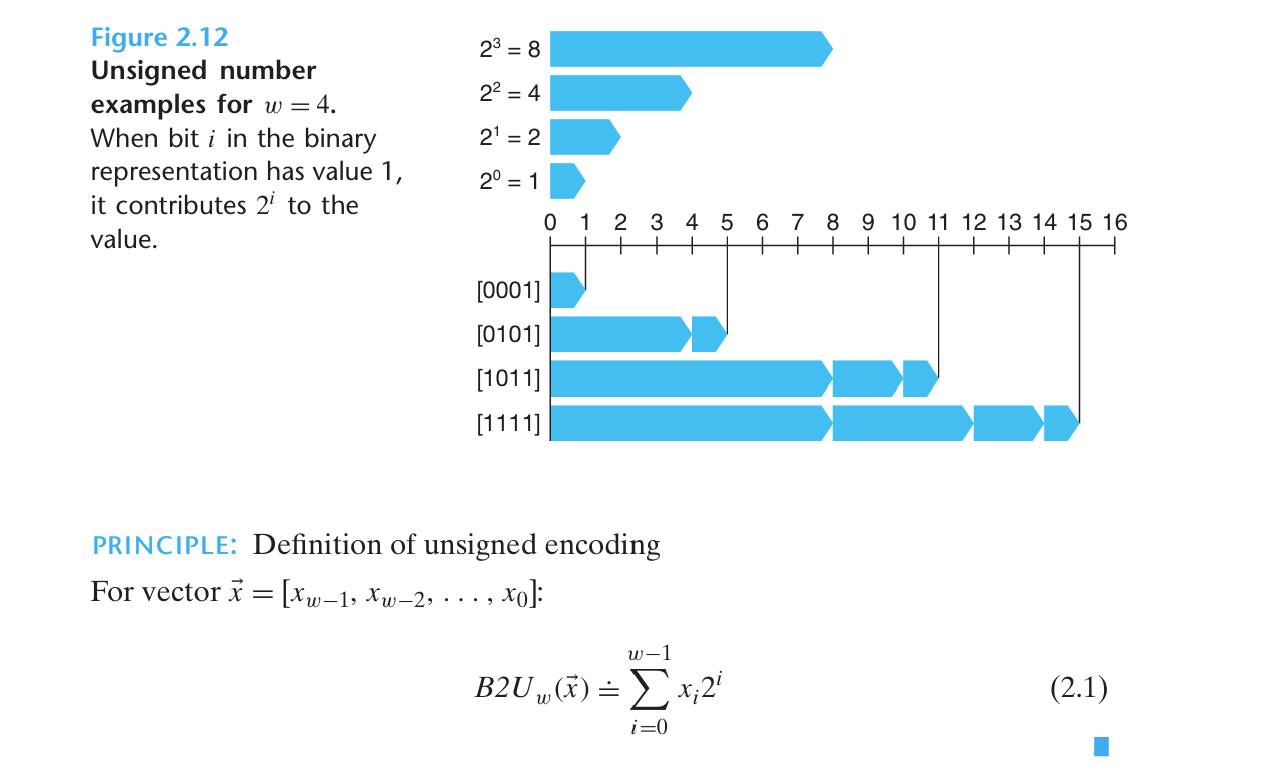
等号上加一个点意思是左边被定义成等于右边,函数是Binary to Unsigned的缩写,长度为,它将一个长度为的0、1串映射到非负整数,计算方法就是把0、1串看作二进制表示,例如
Function is a bijection.
双射的意思是一一对应,不了解的读者可以自行搜索了解,即在到之间的整数的位无符号编码是独一的
2.3 Two’s-Complement Encodings
For many applications, we wish to represent negative values as well. The most common computer representation of signed numbers is known as two’s-complement(补码) form. This is defined by interpreting the most significant bit of the word to have negative weight. We express this interpretation as a function (for “binary to two’s complement” length ).
The most significant bit is also called the sign bit(符号位)
例如,$$B2T_4([1011]) = -2^3 + 2^1 + 2^0 = -5$$
同样地,也是个双射,它的范围是到,我们定义作为它的反函数
补码编码中,符号位为1的编码表示负数,符号位为0的编码表示非负数,所以负数的范围比正数多一个数,而无符号数和补码在位一样的情况下表示的数的个数是一样多的,所以补码中的负数在无符号表示中都变成了正数有
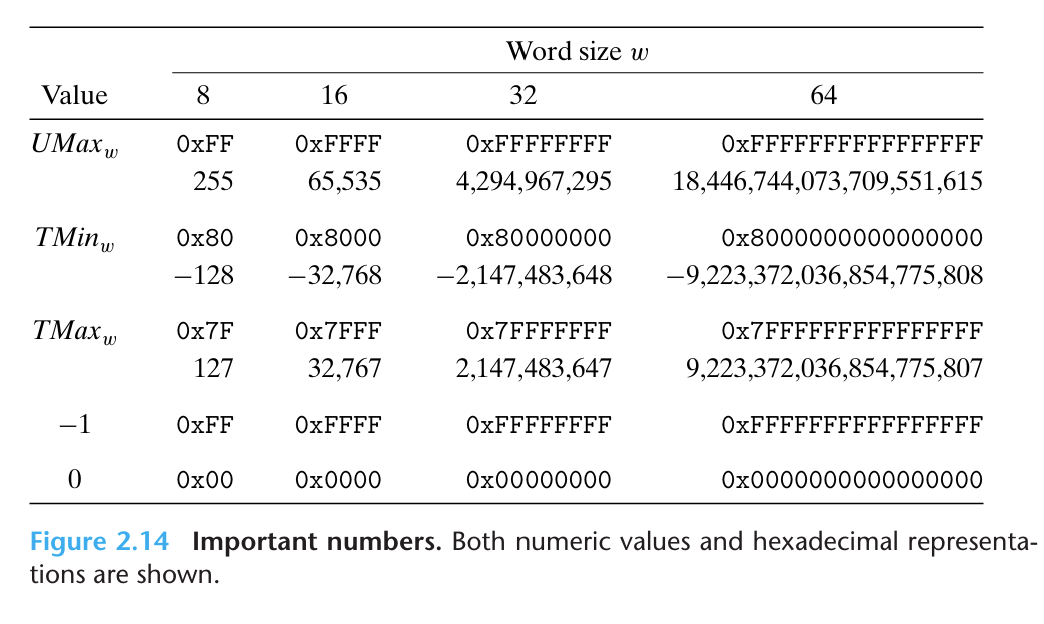
The C standards do not require signed integers to be represented in two’s
complementform, but nearly all machines do so.
2.4 Conversions between Signed and Unsigned
C allows casting between different numeric data types. For example, suppose variable x is declared as int and u as unsigned. The expression (unsigned)x converts the value of x to an unsigned value, and (int)u converts the value of u to a signed integer.
For most implementations of C, the effect of casting is to keep the bit values identical but change how these bits are interpreted.
1 | short int v = -12345; |
2.5 Signed versus Unsigned in C
Although the C standard does not specify a particular representation of signed numbers, almost all machines use two’s
complement. Generally, most numbers are signed by default. For example, when declaring a constant such as 12345 or 0x1A2B, the value is considered signed. Adding character ‘U’ or ‘u’ as a suffix creates an unsigned constant; for example, 12345U or 0x1A2Bu.
When printing numeric values with printf, the directives %d, %u, and %x are used to print a number as a signed decimal, an unsigned decimal, and in hexadecimal format, respectively. Note that printf does not make use of any type information, and so it is possible to print a value of type int with directive %u and a value of type unsigned with directive %d.
1 | int tx, ty; |
In printf("ux = %u = %d\n", ux, ux);, printf prints the word first as if it represented an unsigned number and second as if it represented a signed number.
When an operation is performed where one operand is signed and the other is unsigned, C implicitly casts the signed argument to unsigned and performs the operations assuming the numbers are nonnegative.
It leads to nonintuitive results for relational operators such as < and >.

2.6 Expanding the Bit Representation of a Number
One common operation is to convert between integers having different word sizes while retaining the same numeric value. Of course, this may not be possible when the destination data type is too small to represent the desired value. Converting from a smaller to a larger data type, however, should always be possible.
To convert an unsigned number to a larger data type, we can simply add leading zeros to the representation; this operation is known as zero extension(零扩展).
For converting a two’s-complement number to a larger data type, the rule is to perform a sign extension(符号扩展), adding copies of the most significant bit to the representation.
1 | short sx = -12345; /*-12345*/ |
可以用数学归纳法证明符号扩展不改变数值
需要注意的是,一个数据大小到另一个数据大小的转换以及无符号和有符号数间的转换,转换的相对顺序能影响一个程序的行为
1 | short sx = -12345; |
这表明把short转换成unsigned时,先改变大小变为int,再从有符号数转为无符号数
即(unsigned) sx等价于(unsigned) (int) sx
2.7 Truncating Numbers
1 | int x = 53191; /* c7 cf 00 00 */ |
Casting x to be short will truncate(截断) a 32-bit int to a 16-bit short. As we saw before, this 16-bit pattern is the two’s-complement representation of −12,345. When casting this back to int, sign extension will set the high-order 16 bits to ones, yielding the 32-bit two’s-complement representation of −12,345.
当将一个位的数截断成一个位数时,我们会丢弃高位的位
2.8 Advice on Signed versus Unsigned
3 Integer Arithmetic
3.1 Unsigned Addition
如果两个非负整数,它们大于等于0小于,那么它们的和可能为,因此,无符号数作加法时,位数不能有上限
我们为参数定义运算,其中,这个运算是把整数和截断为位,然后把它看作无符号数得到结果,这实际上是种模运算,即对模,例如,用4个bit表示数字,x = 9, y = 12
即[1001]和[1100],它们的和为21,即[10101]但我们得到的结果是[0101] = 5
而
An arithmetic operation is said to overflow when the full integer result cannot fit within the word size limits of the data type.
比如我们可以写一个判断加法计算是否发生溢出的函数
1 | /* Determine whether arguments can be added without overflow */ |
Modular addition forms a mathematical structure known as an abelian group(阿贝尔群)
That is, it is commutative(可交换的) and associative(可结合的); it has an identity element 0, and every element has an additive inverse(加法逆元). Let us consider the set of w-bit unsigned numbers with addition operation . For every value , there must be some value such that
3.2 Two’s-Complement Addition
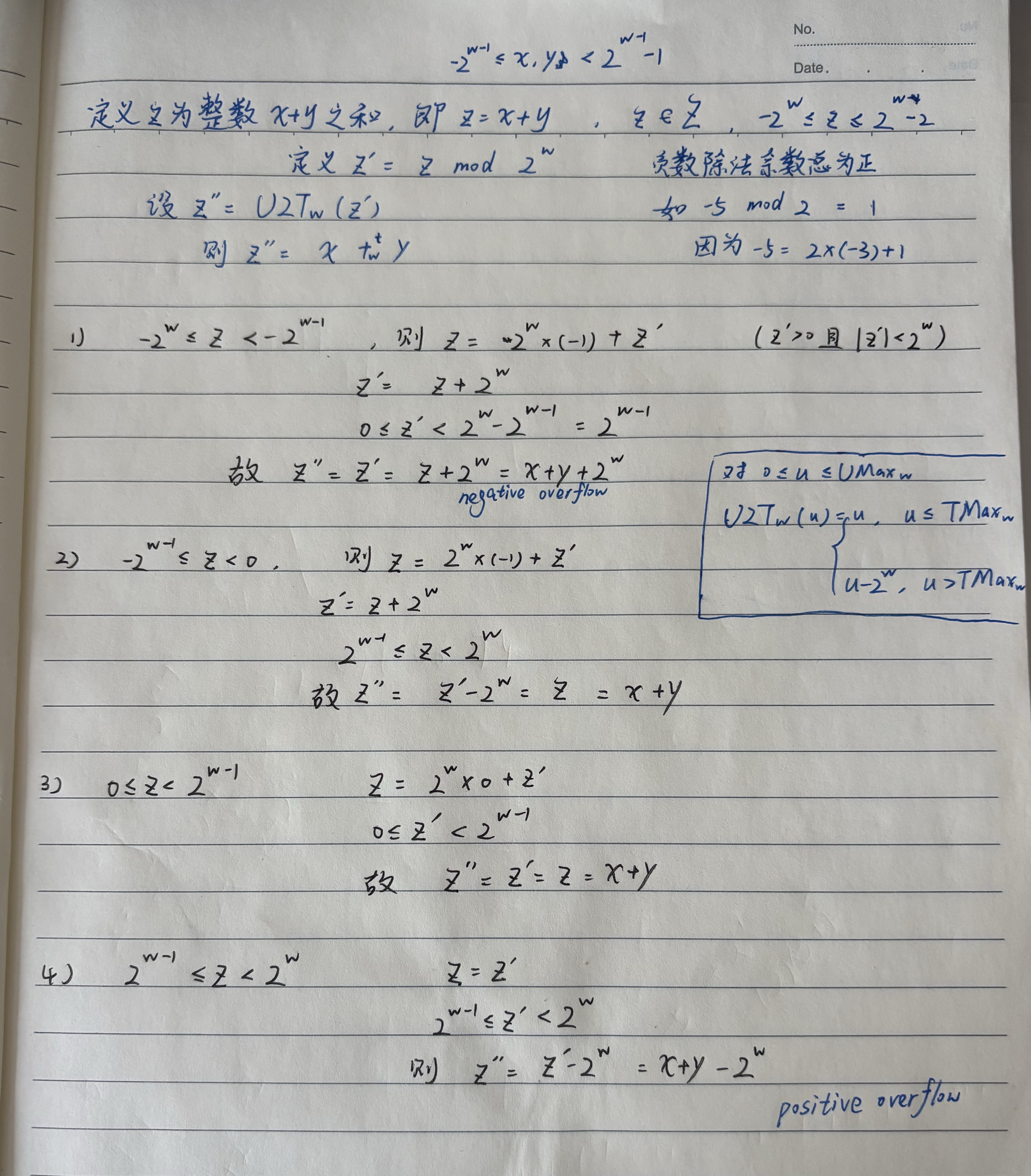
Given integer values and in the range , their sum is in the range , potentially requiring bits to represent exactly.
Let us define to be the result of truncating the integer sum to be bits long and then viewing the result as a two’s-complement number.
Two’s-complement addition
For integer values in the range ,
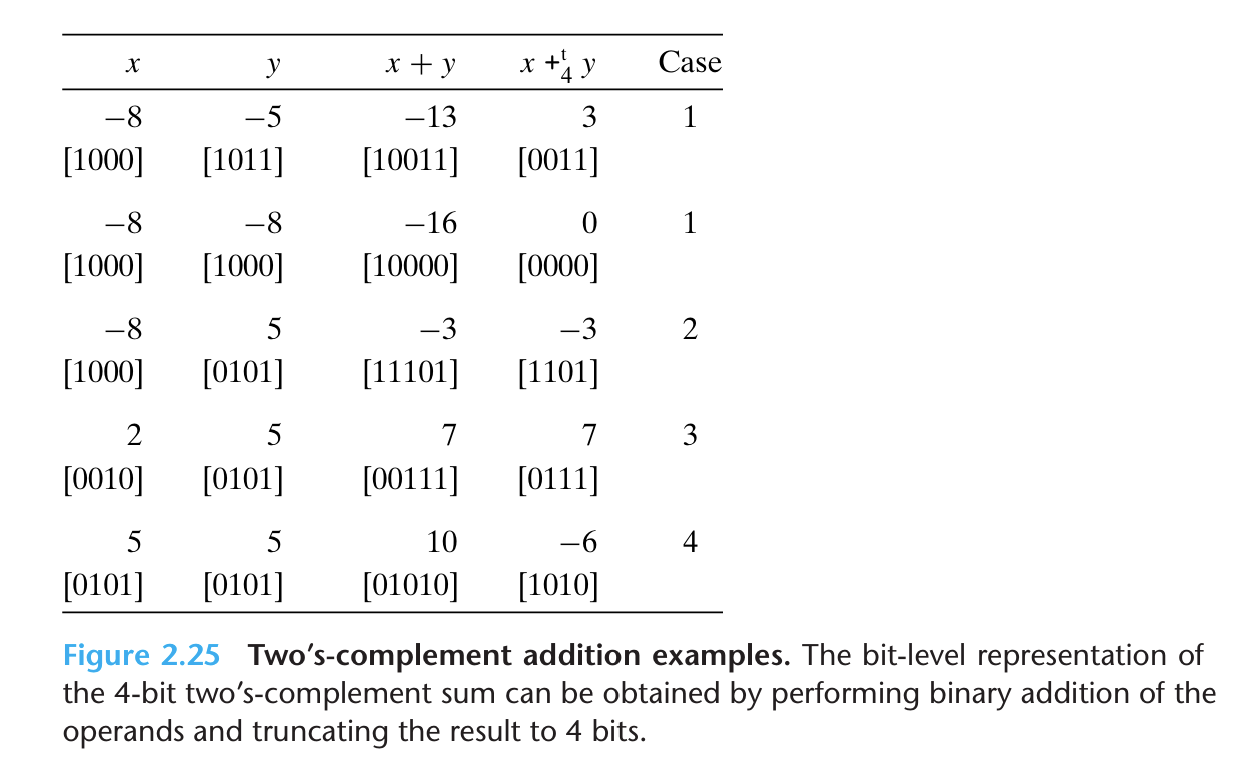
根据的取值,如果超过,即上面第一种情况,称为positive overflow
如果小于,我们称为negative overflow
从bit串的角度去看,两个数的位补码之和和无符号之和是完全一样的,只是理解方式不一样
因此
3.3 Two’s-Complement Negation
Every number in the range has an additive inverse under , which we denote
当时,,导致negative overflow,所以
而时,都可以用一个位的补码数来表示,它们的和是,故
计算一个用bit串表示的数的补码非,有几种快速的方法
第一种是对每一位取反,然后再对结果加1,在C语言中,对于任意整数值x,-x和~x+1得到的结果一样
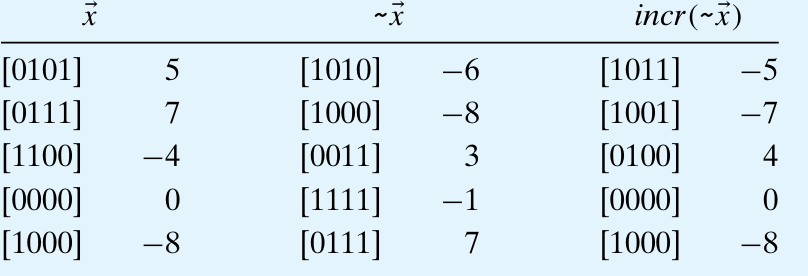
第二种方法是,对于这个值的位级表示,从右往左找到第一个1的位置,然后将1左侧的每一个bit都取反
3.4 Unsigned Multiplication
对于整数,它们的乘积最大为,需要位来表示,乘法我们也定义为将结果截断成位并把它视为补码表示进而得到数值
由于无符号数是非负的,于是对,有
3.5 Two’s-Complement Multiplication
对于的整数,最大上限是,这需要位来表示(注意补码最高位是负权)
同样地,我们也是得到结果后截断成位,这等价于把模,尽管可能是负的,但取模后的结果一定是截断+按无符号数去理解,这是因为任何整数都可以写成,而对应的都是第位及以上的内容。例如-10 = 4 * (-3) + 2
[10110] = -16 + 4 + 2 = 4 * (-3) + 2
截断成2位为[10]=2
Two’s-complement multiplication
For such that :
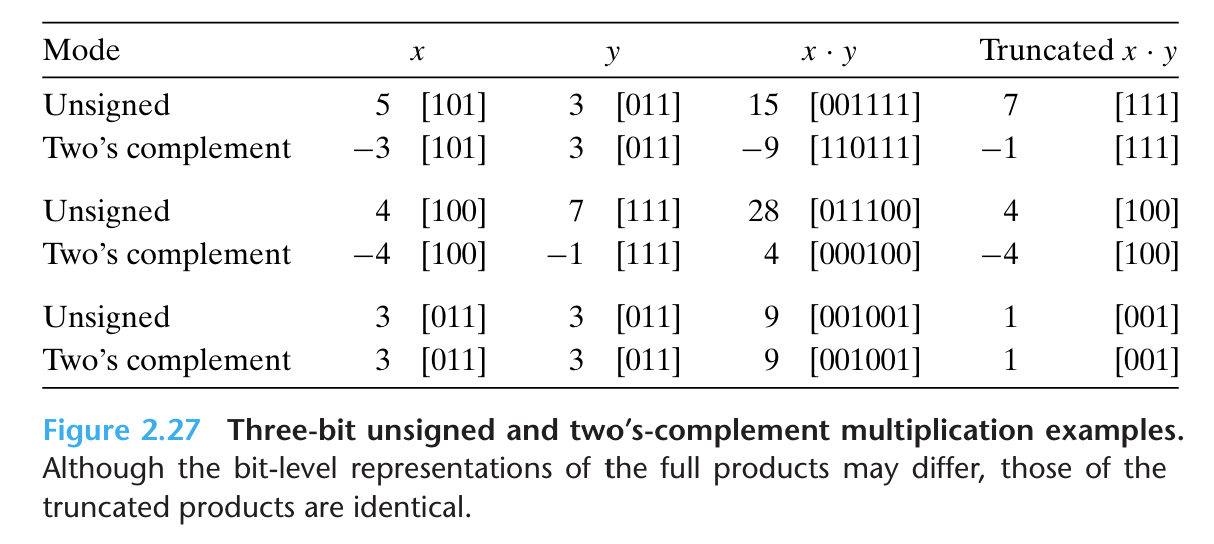
Bit-level equivalence of unsigned and two’s-complement multiplication
设是长度为的位向量,设
那么
即对无符号数和补码乘法来说,乘法运算的结果的位级表示(截断后)是一样的
推导:
,于是
而
两边同时应用,有
于是
两边同时应用,有
3.6 Multiplying by Constants
Historically, the integer multiply instruction on many machines was fairly slow, requiring 10 or more clock cycles, whereas other integer operations—such as addition, subtraction, bit-level operations, and shifting—required only 1 clock cycle.
As a consequence, one important optimization used by compilers is to attempt to replace multiplications by constant factors with combinations of shift and addition operations.
由于整数乘法比移位和加法的代价要大,C语言编译器试图以移位、加法和减法的组合来消除整数乘常数的情况,比如x * 14,由于编译器会将乘法重写为(x<<3) + (x<<2) + (x<<1)或者(x<<4) - (x<<1)
根据我们上面的说明,无论x是无符号数还是补码数,无论乘法过程有没有溢出,结果都是对的
一般地,对于x * K,编译器可以以二进制的形式表示K,比如[(0…0)(1…1)…(1…1)(0…0)],像14就是[(0…0)(111)(0)],对于第到第个位置的连续的1(14中,n=3,m=1),可以有两种形式
x<<n + x<<(n-1) + ... + x<<mx<<(n+1) - (x<<m)
比如K=55,只要求用2次加/减法和2次移位
[110111]可以看成[111111]减去中间那个1即,于是为(x<<6) - x<<0 - x<<3 = x<<6 - (x<<3) - x
或者分成两块处理,即x<<6 - (x<<4) + (x<<3) - (x<<0) = x<<6 - (x<<3) - x
当然,并不是说乘常数都要化成加减法和移位的形式,这取决于这些指令在特定机器上的相对速度,大多数编译器只有在只需要少量移位、加减法就足够的时候才进行优化
3.7 Dividing by Powers of 2
Integer division on most machines is even slower than integer multiplication — requiring 30 or more clock cycles.
整数除法总是舍入到0,即如果x/y结果是正数,向下取整,如果x/y结果是负数,向上取整
3.8 Final Thoughts on Integer Arithmetic
As we have seen, the “integer” arithmetic performed by computers is really a form of modular arithmetic. The finite word size used to represent numbers limits the range of possible values, and the resulting operations can overflow.
We have also seen that the two’s-complement representation provides a clever way to represent both negative and positive values, while using the same bit-level implementations as are used to perform unsigned arithmetic—operations such as addition, subtraction, multiplication, and even division have either identical or very similar bit-level behaviors, whether the operands are in unsigned or two’s complement form.
4 Floating Point
In this section, we will see how numbers are represented in the IEEE floating point format. We will also explore issues of rounding, when a number cannot be represented exactly in the format and hence must be adjusted upward or down
ward. We will then explore the mathematical properties of addition, multiplication, and relational operators.
4.1 Fractional Binary Numbers
例如
十进制小数转二进制,每次用小数部分乘2,并记录乘积的整数部分,并用剩下的小数部分继续乘,直到小数部分为0,然后顺序排列取出的整数
有些数,例如0.2,不能准确地表示为一个二进制小数,会一直循环下去,这时只能根据精度要求增加二进制表示的长度
4.2 IEEE Floating-Point Representation
The IEEE floating-point standard represents a number in a form
- The sign s determines whether the number is negative (s=1) or positive.
- The significand(尾数) M is a fractional binary number that ranges either between and or between and . (这里是指)
- The exponent(阶码) E weights the value by a (possibly negative) power of 2.
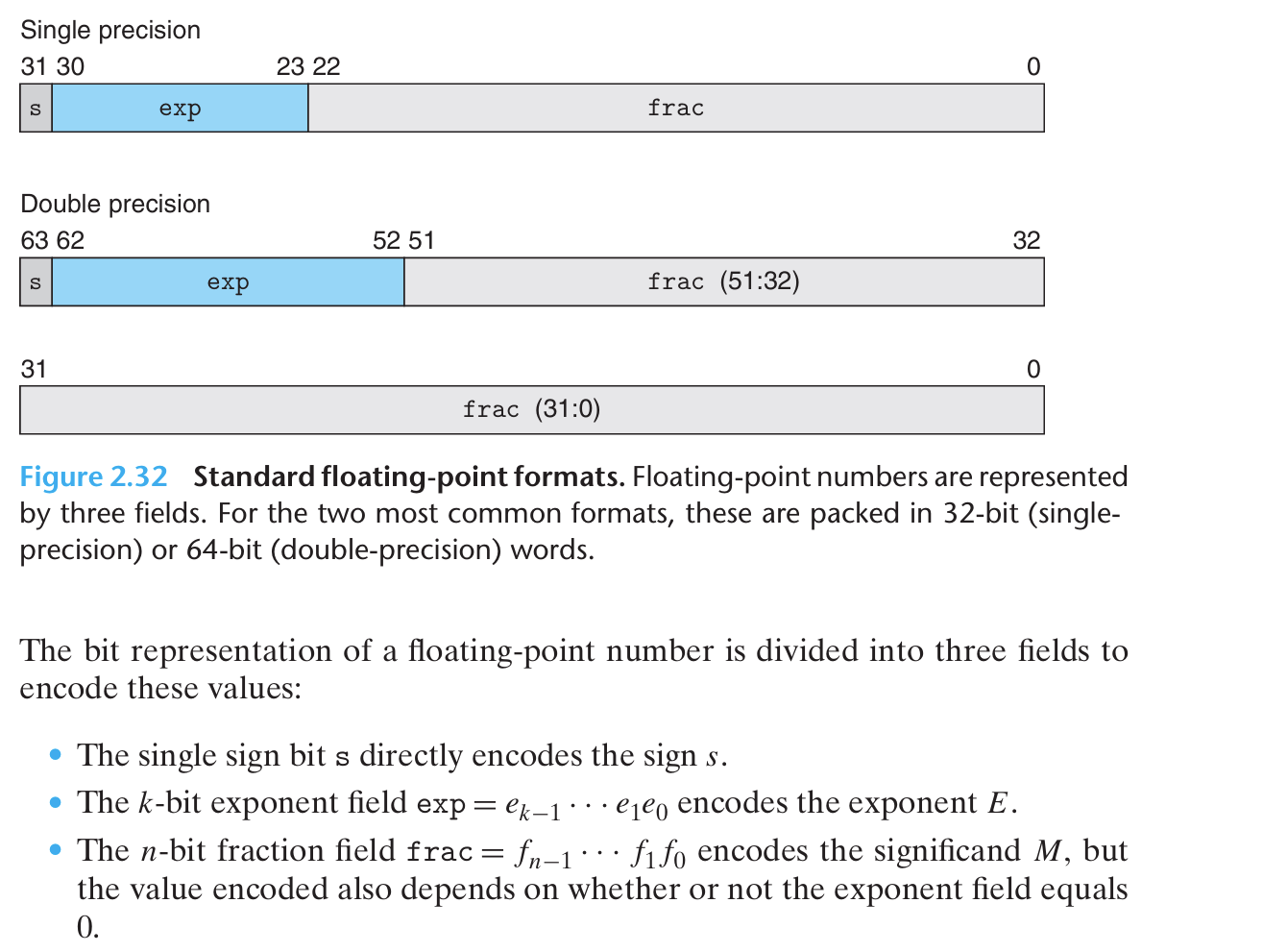
The value encoded by a given bit representation can be divided into three different cases (the latter having two variants), depending on the value of exp.
4.2.1 Normalized Values
此时exp不是全0也不是全1,阶码此时被理解为一个以偏置(biased)形式表示的有符号数,阶码的值为,其中是无符号数,位表示为,双精度范围是1~2046,是一个等于(单精度为127,双精度为1023)的偏置值,所有指数的范围,对单精度是-126~127,对双精度是-1022~1023
The fraction field frac is interpreted as representing the fractional value ,
where , having binary representation , that is, with the binary point to the left of the most significant bit. The significand is defined to be
. This is sometimes called an implied leading 1representation, because we can view to be the number with binary representation . This representation is a trick for getting an additional bit of precision for free, since we can always adjust the exponent so that significand is in the range (assuming there is no overflow).
4.2.2 Denormalized Values
When the exponent field is all zeros, the represented number is in denormalized form. In this case, the exponent value is , and the significand value is .
非规格化数有两个用途
- 提供了表示0的方式,因为规格化数的情况下M总是大于等于1,事实上,00…0表示+0.0而10…0表示-0.0,它们在某些方面被认为是不同,其他方面是相同的
- 表示非常接近0.0的数
4.2.3 Special Values
A final category of values occurs when the exponent field is all ones. When the
fraction field is all zeros, the resulting values represent infinity, either when or when . Infinity can represent results that overflow, as when we multiply two very large numbers, or when we divide by zero. When the fraction
field is nonzero, the resulting value is called a NaN, short for “not a number.” Such values are returned as the result of an operation where the result cannot be given as a real number or as infinity, as when computing or .
4.3 Example Numbers
我们以8位浮点数为例,的阶码位和的小数位
对于非规格化数,总要乘,最大就是,而最小的规格化数是,因此,做到了最大非规格化数和最小规格话数的平滑转变,这归功于非规格化数中对的定义
最大的规格化数为0 1110 111,,,值为
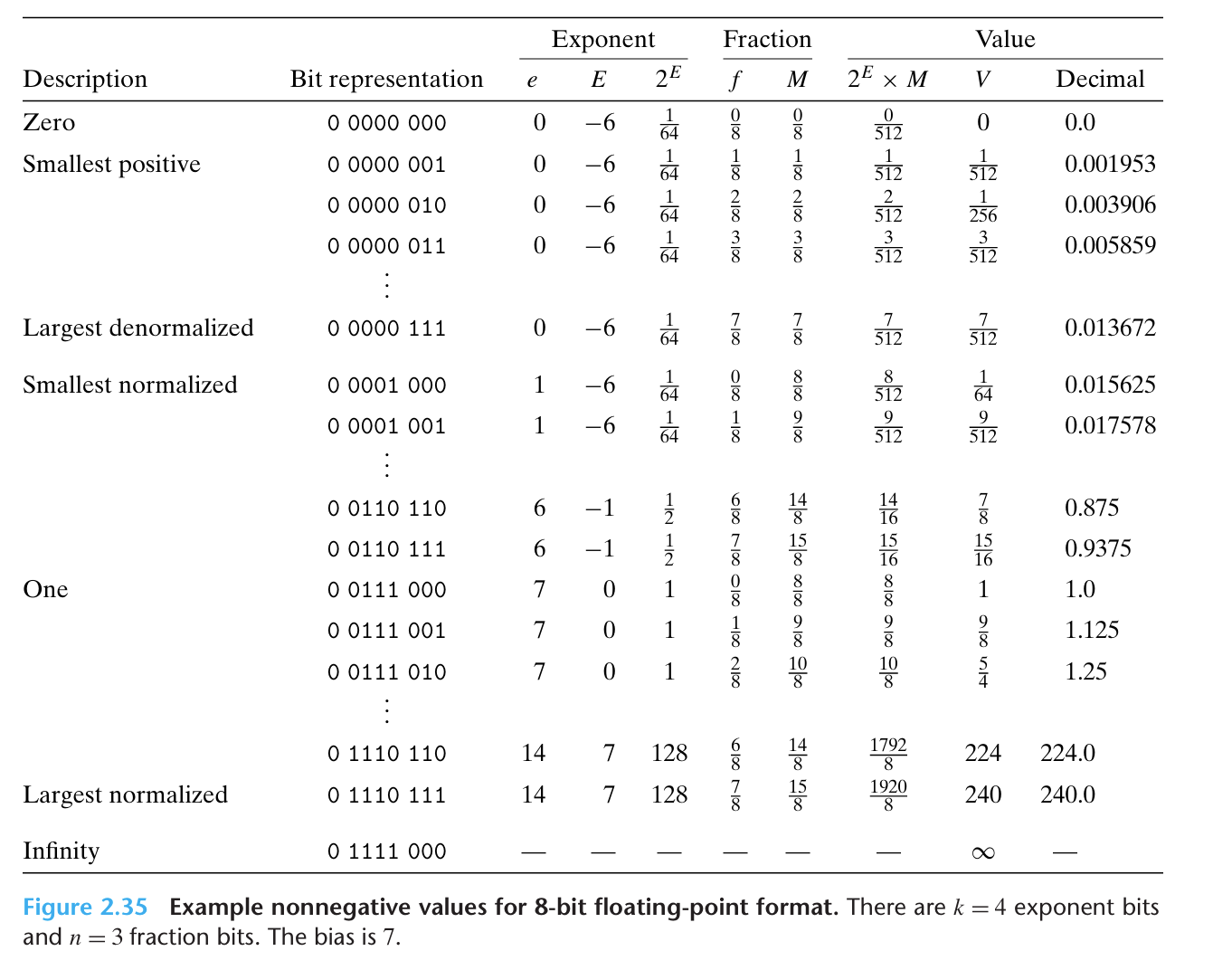
对于一些特殊数值,我们可以得到如下结论
- +0.0的位表示全为0
- 最小的正非规格化数的位表示,是最低有效位为1而其他位为0
- 最大的非规格化数的位表示,是阶码字段全为0而小数字段全为1
- 最小的正规格化数的位表示是阶码字段最低有效位为1,其他位都为0
- 值1.0的位表示是阶码字段除最高位外都为1,其他位为0,这样
- 最大的规格化数的位表示为符号位为0、阶码的最低有效位为0(其他均为1,这样防止变成无穷),其他位均为1
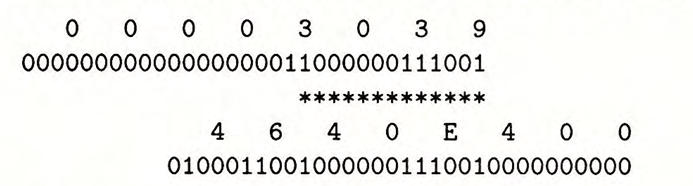
我们来试着把整数值转换成浮点形式,例如,对于12345,它的二进制表示是[11000000111001],于是有
用单精度形式编码,开头的1丢弃,剩下的就是小数部分,对应小数字段,即[10000001110010000000000],偏置量是127,那么阶码字段就应该是13+127=140,即[10001100]
最后,浮点表示可以表示的数并不是均匀分布的,越靠近0它们越稠密,这是因为小数字段的位数是固定的,每组数都要乘,设小数字段的位数为,那么在固定的下,相邻浮点数间隔为
以6位浮点数为例,,偏置为3
非规格化数,,小数为0~,即,间隔就是
规格化数一开始也是,后面时,小数字段,即的范围是,每个数还要乘,间隔就是
所有非负数是
4.4 Rounding
一个真实的数或者精确的运算结果,无法用当前浮点格式精确表示时,计算机该选附近哪个可表示的浮点数呢?
例如,某种浮点格式只能表示2.00,2.25,2.50,2.75,现在要保存2.63,必须挑2.50或2.75来表示,关键在于舍入方向
IEEE浮点格式定义了4种舍入方式(rounding modes)
4.4.1 Round-toward-zero
向0舍入,即正数向较小值舍入,负数向较大值舍入
4.4.2 Round-down & Round-up
向下舍入,即总向较小值舍入,向上舍入同理
4.4.3 Round-to-even
这是默认的舍入模式,它找最靠近的可表示的浮点数来舍入,比如舍入到整数,1.6舍入到2,1.4舍入到1,对于1.5,它比较特殊,会舍入到偶数,即1.5舍入到2,但2.5也舍入到2
如果不是舍入到整数,向偶数舍入就考虑最低有效位的数字是奇数还是偶数,比如我们想把十进制数舍入到百分位,例如1.23499999舍入到1.23,1.23500001舍入到1.24,因为它们并不是在1.23和1.24正中间,而1.23500000和1.2450000都舍入到1.24,因为4是偶数
同样地,向偶数舍入也可以应用到二进制表示的小数里,我们认为最低位为0就是“偶”,最低位为1就是“奇”
怎么判断刚好在中间呢?假设是要保留的部分,如果这个二进制小数形如,那么就说明是在正中间,例如保留到小数点右边2位,位,就是1.375,位于1.25和1.5正中间,那么这时就要向偶数舍入,即摄入为
例如,舍入到小数点右边2位
,它的剩余部分是01100…,小于100…,向更靠近的舍入即可
,它的剩余部分是1100…,大于100…,因此向更靠近的舍入即可
但对于,在正中间,我们向偶数舍入,得到,又如,舍入到
4.5 Floating-Point Operations
IEEE标准规定了一个简单的规则,来确定算术运算的结果,即把浮点值看成实数,精确地进行运算后再进行舍入,得到结果
这种规定运算行为和结果的好处是,它独立于任何具体的硬件或软件实现,我们不需要知道具体是怎么实现运算的,但我们知道最后的结果必须是什么
我们定义,由于溢出,该运算可能得到无穷值,这个运算可交换但不可结合,例如单精度浮点下(3.14+1e10)-1e10会由于舍入,3.14会丢失,得到结果0.0
大多数值在浮点加法下有逆元,除了无穷和NaN,因为
由于不满足结合律,原本编译器可能将x = a + b + c; y = b + c + d;优化成t = b + c; x = a + t; y = t + d;来省去一个浮点加法,但这使用了加法运算的结合律,编译器会保守地避免这种优化
浮点加法满足单调性,如果不是NaN的,那么对于不是NaN的任何,有,无符号加法和补码加法并不具备这个属性,例如4位无符号数,虽然,但
同样地,定义,结果可能是无穷或者NaN,满足交换律,且满足,但不满足结合律,例如单精度浮点数,
浮点乘法也不满足分配律,例如
但
浮点乘法也满足单调性,对于不是NaN的,有
同样,若,有
此外,只要,就有
对于特殊参数,IEEE标准还定义了如等规则
4.6 Floating Point in C
All versions of C provide two different floating-point data types: float and double. On machines that support IEEE floating point, these data types correspond to single- and double-precision floating point. In addition, the machines use the round-to-even rounding mode.
Unfortunately, since the C standards do not require the machine to use IEEE floating point, there are no standard methods to change the rounding mode or to get special values such as ,or .
Most systems provide a combination of include (.h) files and procedure libraries to provide access to these features, but the details vary from one system to another. For example, the GNU compiler GCC defines program constants INFINITY (for ) and NAN (for ) when the following sequence occurs in the program file:
1 |
When casting values between int, float, and double formats, the program changes the numeric values and the bit representations as follows (assuming data type int is 32 bits):
-
From
inttofloat, the number cannot overflow, but it may be rounded.(float范围虽然比int大得多,但它不能精确表示所有int,因为虽然范围大,但数值之间的间隔也会越来越大) -
From
intorfloattodouble, the exact numeric value can be preserved becausedoublehas both greater range (i.e., the range of representable values), as well as greater precision (i.e., the number of significant bits(有效位数)). -
From
doubletofloat, the value can overflow to or , since the range is smaller. Otherwise, it may be rounded, because the precision is smaller. -
From
floatordoubletoint, the value will be rounded toward zero. For example, 1.999 will be converted to 1, while −1.999 will be converted to −1. Furthermore, the value may overflow. The C standards do not specify a fixed result for this case. Intel-compatible microprocessors designate the bit pattern [10 …00] ( for word size ) as an integer indefinite value. Any conversion from floating point to integer that cannot assign a reasonable integer approximation yields this value. Thus, the expression(int) +1e10yields-2147483648, generating a negative value from a positive one.